
![[at]](/sites/default/files/at.png) bogazici.edu.tr
bogazici.edu.tr



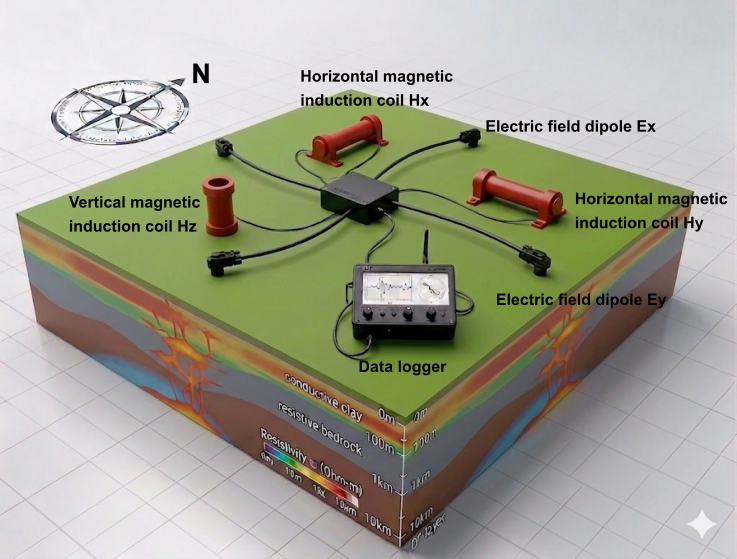
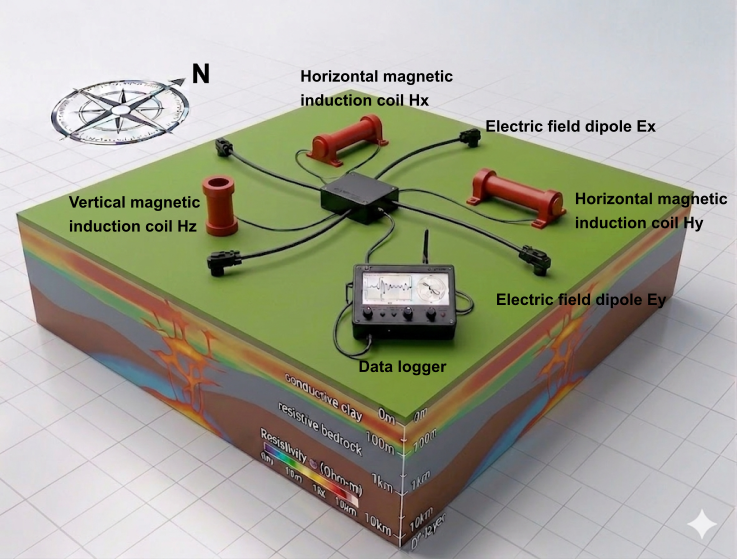
The Magnetotelluric (MT) method is a passive electromagnetic (EM) geophysical exploration technique used to image the subsurface electrical conductivity structure of the Earth from depths of a few tens of meters down to the upper mantle (several hundred kilometers). It relies on measuring natural fluctuations in the Earth's magnetic and electric fields.
-
High Frequencies (>1 Hz): Sourced from lightning activity (sferics) in the atmosphere.
-
Low Frequencies (<1 Hz): Sourced from the interaction between solar wind and the Earth's magnetosphere.
These time-varying magnetic fields induce telluric (electric) currents in the ground. By measuring these induced fields simultaneously, the method determines the Earth's electromagnetic impedance.
A standard MT station typically records five components. The electric fields (Ex,Ey) are measured using non-polarizable electrodes (porous electrodes) connected by wires laid out in an L-shape (North-South and East-West). The magnetic fields (Hx,Hy,Hz) are measured using induction coils or fluxgate magnetometers.
